




Durability versus fast fashion 1

Durability versus fast fashion

Original content by: Lederpiel

The international leather (Cotance), footwear (CEC), fur (IFF) and wool (IWTO) associations have joined forces to defend natural and durable materials against fast fashion. These four organisations have produced a joint statement addressed to the Technical Secretariat of the Product Environmental Footprint Standards Category (Pefcr) on Clothing and Footwear (A&F). In it they express their disagreement with the current method for calculating the “service life” of clothing and shoes. According to Cotance, CEC, IFF and IWTO, the main concern is the precedent that this calculation method is setting in the broader EU regulatory context. “An immature methodology for calculating the environmental footprint of clothing and footwear products risks having highly damaging effects on the diversity and competitiveness of industries in the ecosystem”, the associations say.

What is wrong with current durability metrics for clothing and footwear? According to these four representative organisations for leather, footwear, fur and wool, they penalise natural and longer-lasting materials, and consumer products made from them.

Joint statement

The main concern lies in the unit of measurement adopted by the Technical Secretariat, which develops the methodology and the representativeness of the default values ​​for the durability of clothing and footwear products taken from Higg.

The signatories of the joint statement oppose the measure being expressed in a number of “uses” rather than in real time in “years”. This approach, taken from the Higg Product Module, “does not reflect the real lifespan of products or the opinion of all stakeholders in the sector”, explain the four associations. In addition, neither the product segmentation nor the default values ​​for service life take into account the unique properties of the different materials. “As a result, the method favours products that are purchased and thrown away after just a few ‘uses’ and penalises those designed to last much longer than the methodology can deliver,” the signatories of the joint statement say.

The organisations representing the views of the footwear, fur, leather and wool industries propose that service life be expressed in years rather than uses and that the durability characteristics that materials confer on products be appropriately integrated into product segmentation or the reference flow. “This change would provide a more accurate and meaningful assessment of a product’s lifespan, helping both consumers and manufacturers make informed decisions,” they say.

You can access the original article HERE
The tanning sector must see itself as a circular economy system 3

The tanning sector must see itself as a circular economy system

Original content by: Real Leather

The circular economy is a sustainable and innovative economic model that seeks to redefine the traditional linear “take, make, dispose” model of production and consumption. Instead, it promotes a system where resources are used for as long as possible, the maximum value is extracted from them while they’re in use, and products and materials are then recovered and regenerated at the end of their useful life.

How does the circular economy work?

The circular economy can be visualized as a loop. These are the steps to make that loop as smooth as possible.

Firstly, design out waste and pollution: This starts with the design of products. In a circular economy, products are designed to be durable, easy to repair, and recyclable. Leather comes from a by-product. If not used it would be wasted.

Keep products and materials in use. Create products that last longer, and then find ways to repurpose or recycle them rather than discarding them. This could involve creating sharing platforms, remanufacturing, and recycling.

Regenerate natural systems. Restore and regenerate natural capital, for example, by returning valuable nutrients to the soil or purifying air and water.

Benefits to the leather business

Cost savings. By recycling and reusing materials, businesses can reduce procurement costs. Leather as an alternative to forever plastics makes sound ecological sense.

New revenue streams. By repurposing leather, fashion and practical application of leather can be discovered which in turn will find new markets and revenue opportunities.

Innovation. rethinking products and processes can drive innovation and differentiation in the market.

Resilience. A circular approach can make supply chains more resilient by reducing dependency on scarce resources.

Improved brand image. By using leather that would otherwise be wasted we can show commitment to sustainability and enhance a company’s reputation and customer loyalty.

You can access the original post HERE 

EU leather and footwear industry demands improvements to legislative framework 5

EU leather and footwear industry demands improvements to legislative framework

Original content by: Lederpiel

The European Platform of Chemical Manufacturing Industries (CheMI) has signed a letter demanding regulatory improvements for the legislative framework for chemicals in the European Union. CheMI represents more than 300,000 European companies, 14 industry associations (including the European Footwear Confederation (CEC) and the Confederation of National Associations of Tanners of the European Community (Cotance)), 3 million employees and a turnover of 500 billion euros. The letter focuses on four main demands:

  • Consider the impact on downstream users when regulating chemicals. This can be achieved by conducting comprehensive impact assessments that include the entire value chain and establishing viable transition periods so that companies can anticipate and implement changes.
  • Improve market surveillance to develop competition. All chemicals imported into the EU must comply with current legislation and, therefore, strengthened surveillance is necessary to achieve a level playing field.
  • The competitiveness of European companies must be a priority.
  • Promote better regulation. Duplicate and overlapping requirements, as well as complex regulations, should be avoided to alleviate unnecessary burdens on businesses.

Likewise, CheMI calls for including all stakeholders in the value chain in the development of impact assessments on new legislation or in the preparation of secondary legislation and guidance for law enforcement.

TCLF industries sign industrial agreement for the EU

Representatives of the European textile, clothing, leather and footwear (TCLF) industries have called on European Union policymakers to commit to protecting their sectors and the quality of the jobs they generate. To protect this industrial network from problems such as global competition, energy prices, increased legislation or the aging of its workforce, the interlocutors of these sectors have signed an industrial agreement with seven main demands:

  • Ensure a just transition while protecting jobs.
  • Develop a recycling and training program for workers that guarantees qualified professionals and attracts new generations.
  • Promote social dialogue and participation with social partners.
  • Ensure a sensible, stable and coherent regulatory environment for European industries, improving single market regulations and continuing to maintain competitiveness.
  • Access to energy and raw materials.
  • Free and fair trade to ensure equal conditions.
  • Increase in demand for organic products in the EU.

You can access the original post HERE and HERE

Workplace safety and minimizing carbon footprint: Green Deal Leather goals 7

Workplace safety and minimizing carbon footprint: Green Deal Leather goals

Original content by: Lederpiel

On May 16, the social partners of the European leather industry, the Cotance employers’ association and the IndustriAll-Europe syndicate, held the final conference of the Green Deal Leather project in Brussels (Belgium) after two years of work. The event attracted around a hundred attendees and marked the end of a project in which the national tanning associations of Spain (Acexpiel), Portugal (APIC), France (FFTM), Hungary (MKZS), Italy (UNIC), Germany (VDL) and Austria (FVTBSL).

The main goal of the project was to know with primary data the real situation of the leather industry in aspects so relevant to advancing the circular economy such as safety in the workplace within tanneries and the carbon footprint of leather generated by the tanning activity. In this sense, during the introduction of the conference, Gustavo González-Quijano, general secretary of Cotance, commented on some of the main conclusions of the project’s research. In relation to work accidents, González-Quijano pointed out that these decreased by 16% in two years in the countries participating in the study (Italy, Spain, France, Germany, Portugal, Hungary and Austria); that is, from 1,317 accidents in 2019 to 1,102 in 2021. It should be noted that 15% of occupational accidents in the European tanning sector occur in itinere (on the way to or from work) and that more than 90% of recorded accidents are classified as “minor” in severity. Regarding the carbon footprint of leather, the results of the studies indicated that the average emissions are 8 kg of CO2 per square meter of bovine leather produced. In this sense, the majority of the carbon footprint is produced by the chemicals used in the tanning process.

You can access the original post HERE


Fast fashion is out of fashion: how leather is set to become part of the solution 9

Fast fashion is out of fashion: how leather is set to become part of the solution

Original content by: Leather Naturally

As the world grapples with how we can reduce our impact on the environment and actively limit the impacts of climate change, we sit at a vital crossroads in our collective history. Leather is well positioned to be a meaningful part of the solution.

The European Commission has launched an anti-fast fashion campaign specifically designed to educate younger consumers about the negative impacts of fast fashion and to promote the EU Strategy for Sustainable and Circular Textiles. The campaign aims to address issues of over-production associated with fast fashion and to prioritize sustainability and longevity.

The European Union is committed to serious action as part of its 2030 Vision for Textiles the cornerstone of which is sustainable fashion – designed to have a positive impact on people and the planet.

With leather’s inherent properties of durability, reparability and longevity it represents the antithesis of fast fashion. The fact that it utilizes a by-product in order to create a versatile and premium material lends an additional benefit to its key position in the circular economy.

Increasing traceability expectations together with more and more stringent regulations have entirely shifted the modern consumer landscape. Consumers are far more educated than ever before on the provenance of the goods they purchase and the fact that the impacts of their purchasing decisions can be far-reaching.

Within this context, leather takes a by-product that would otherwise need to be disposed of (with its own environmental impacts) and using responsible, traceable and verifiable production processes, offers designers and consumers high quality products that can be repaired, re-cycled and that can last a lifetime.

You can access the original post HERE

Leather Cluster Barcelona publishes a dictionary of natural hides imperfections 11

Leather Cluster Barcelona publishes a dictionary of natural hides imperfections

Original content by: Lederpiel

Animal hide is very complex, proteinaceous in nature, heterogeneous and extremely irregular. The quality of hides is conditioned by several factors that may have affected the animal’s life and may lead to some type of imperfection or defect: parasites, chafing, scars, marks, etc. On the other hand, during the leather tanning process, some irregularities may also occur that affect the quality of the leather.

With the purpose of providing information to the leather industry in this area, Leather Cluster Barcelona has worked for months to develop an exhaustive catalog that serves as a tool for professionals in the sector in identifying the types of imperfections or defects that it may have.

The Dictionary of Natural Skin Imperfections and Production Irregularities presented by Leather Cluster Barcelona contains a compilation of the main imperfections and defects identified in the leather. Specifically, up to twenty-four different types of imperfections have been characterized. The document includes the list of imperfections (name and key characteristics), the coding, the image of the reference hide associated with the defect (identifying the areas of presence of the defect) and detailed examples of each one. Descriptively, each sheet has information about the area (identification of the main location where the defect is usually located), an observations section with clarifications, explanations and details associated with the imperfection or defect, the difficulty of detection (qualitative measure of the degree of difficulty in detecting this defect by the specialist), the impact of the defect on production (indicates the severity of the defect on the finished product and the frequency (estimation of how often the defect is present: one in five hides, one out of ten, one out of fifty or one out of every hundred).

You can read the Dictionary of Natural Skin Imperfections and Production Irregularities HERE

And so you can access the original post HERE

Sustainability: is fashion on a turning point or is it (still) at a dead end? 13

Sustainability: is fashion on a turning point or is it (still) at a dead end?

Original content by: Lineapelle Magazine

Restarting from 42%. In other words, from the percentage  that, according to ICPEN (International Consumer Protection Enforcement Network) identifies the current green hypocrisy. That is, the fact that, online, more than 4 green slogans out of 10 “are exaggerated, false or deceitful”. Greenwashing, in one word. The occasion to take it one step further is offered by BoF (Business of Fashion), a reference portal for fashion and luxury. Unfortunately, this step does not take us much further. To the point that one question necessarily comes up: is fashion actually taking a turn, as far as 360 degrees green is concerned, or is it still at a dead end?

Turning point or dead alley?

BoF elaborates periodically a Sustainability Index. According to its latest edition, “while companies are discussing about sustainability more than ever, actions are delayed, compared with public commitments”. Much storytelling (sometimes close to propaganda), few concrete actions. “The total average score of evaluated companies was just 36 on 100, with a considerable difference between commitment and action”, BoF writes.

The relationship with suppliers

In the end, to really reach their green goals, brands need to make their production area cost-effective in a sustainable way. Which is, nevertheless, part of their universe under the “suppliers” item. With them, they should share long-term investments in technology and tools. But, BoF remarks, “suppliers complain about the fact that t18hey are often left alone, when the issue is paying for the investments. Instead of putting each season suppliers one against the other for prices, brands should establish solid partnerships, even if this could mean that the cost of production will get higher”. Luckily, it does not work like this for everyone. But that’s enough to prevent a real, determined, widespread sustainable turn from happening. And much too often, this is an unbalanced burden on the upper part of the production chain.

You can access the original post HERE

Edition full of vitality and content for Lineapelle 103 15

Edition full of vitality and content for Lineapelle 103

Original content by: Lineapelle

Despite the complex economic situation, LINEAPELLE 103, held at Fiera Milano Rho from 20 to 22 February 2024, celebrates the conclusion of a particularly vital edition that opens up glimmers of confidence for the leather, luxury, and design supply chain.

Twenty-five thousand three hundred seventy-six sector operators (up on the February and September 2023 editions) animated with their interest and search for novelty the stands of the 1,167 exhibitors at LINEAPELLE who showcased collections and projects (reference season: Spring-Summer 2025) characterised by strong innovative research and a clear propensity for diversification of markets, proposals, and destinations.

The influx of foreign operators was significant (39% of the total), with a prevalence of buyers from France, Spain, Germany, Great Britain, Turkey, the United States, and China.

The vitality of LINEAPELLE 103 and its ability to open up new horizons even in a particularly worrying market moment, found expression and (great) interest in all the contents that enriched the exhibition experience, starting with the success of the six Lineapelle Designers Edition fashion shows. Very positive feedback also for the first edition of Lineapelle Interiors / Leather Duets, a business culture exhibition that staged a sequence of installations, each of which was represented by an exclusive leather design project shared between a made-in-Italy leather manufacturer and a furniture company. There was also great involvement for In The Making Atto II (an interconnected and multidisciplinary space where visitors to LINEAPELLE were able to take part in a series of craft workshops using leather) and for the second edition of the Science Based Fashion Talks, opportunities for debate and sharing aimed at discovering and defining green strategies for the entire supply chain.

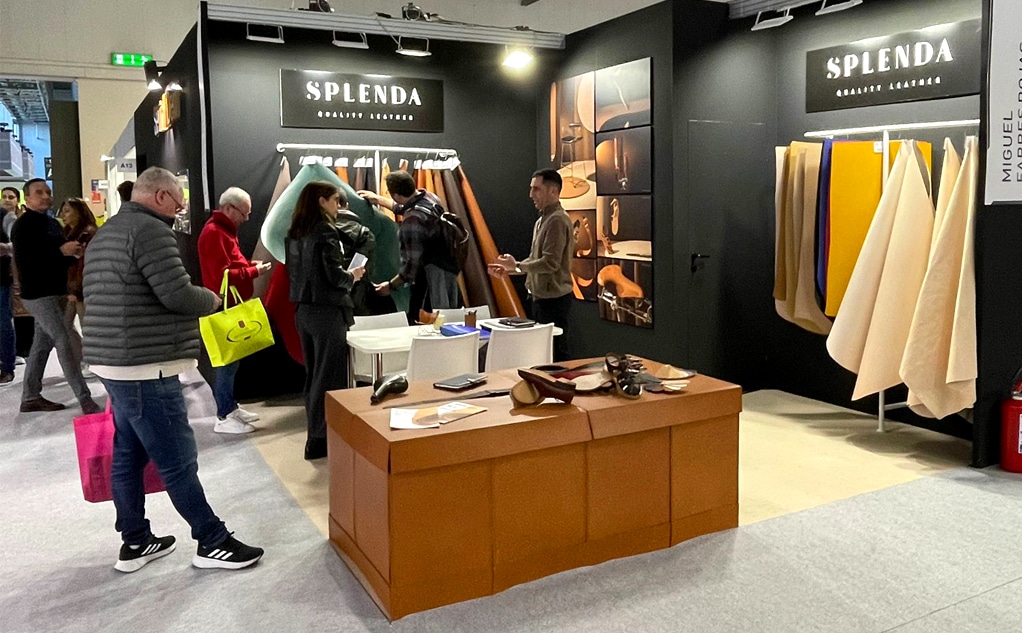
A very profitable edition for Splenda Leather
Splenda Leather attends all editions of Lineapelle in Milan. It is a perfect occasion to perceive new trends in terms of tanning process and leather design.

It is also a great opportunity to strengthen ties with our clients and suppliers. To all of you, thank you very much for visiting us and receiving us. We return home with the firm conviction that, despite the uncertain economic times that many industrial sectors are going through, the health of our industry is strong and we have a good future ahead of us.

You can read the original press release HERE

Alternatives to leather are not always what they seem 17

Alternatives to leather are not always what they seem

Original content by: One4Leather

You have probably heard of the term ‘Vegan Leather’. But what is it really? The name suggests that is derived from plant-based material but is it?

In fact, ‘vegan leather’ isn’t leather at all, nor is it always plant-based. It’s often a material made out polyvinyl chloride (PVC), polyurethane (PU) and textile-polymer composite microfibers or other petroleum-based materials. In layman’s terms: plastics. Some newer alternatives are based on plant or fruit fibres, such as apples or pineapples. The traditional leather alternative materials are artificial and have been around for ages as ‘leather alternatives’, but do not possess the same properties as, nor can they be called leather, as the term is strictly defined according to ISO and other European standards as a tanned hide or skin with its original fibrous structure more or less intact.

‘Vegan’ implies ”free-from” any animal products, which makes naming a vegan material ‘leather’ misleading and even contradictory. This should, however, not be confused with ‘vegetable tanned’ leather, which refers to using tannins that originate from plants, such as the tannin in tree bark. Vegetable-tanned leather though is still genuine leather. Leather alternative materials certainly have achieved higher quality over the years, yet they have decidedly different structures and properties to genuine leather.

As an industry, we believe there is a clear difference between authentic leather and alternatives on various fronts, based on material properties. To illustrate the difference, when you do buy leather, you are choosing a material with the following characteristics:

  • Easy to clean (one of the main reasons why aviation and shared mobility are using it);
  • ‘Breathing’ properties (due to natural fiber structure of the skin);
  • Strength and durability (leather keeps its quality, year-in year-out);
  • Flexibility (leather becomes more and more flexible over time, while it still maintains its shape and strength)
  • Compostability, since leather products can be turned into compost in a matter of weeks as only 1% would remain, which is the surface treatment. This surface coating is the last challenge to make leather a 100% biodegradable material that leaves no footprint in our environment after use.

In the end, it is your choice to make: using or buying artificial material or the real deal. We just wanted to let you know what the difference is, as we believe that transparency is key in order to make a self-conscious decision in what you buy and use.

You can read the original post HERE

Leather makers and EU Industries urge immediate action to conclude EU-MERCOSUR Agreement 19

Leather makers and EU Industries urge immediate action to conclude EU-MERCOSUR Agreement

Original content by: COTANCE

On January 11, 2024, COTANCE joined key EU industries, calling on EU authorities to conclude and ratify the historic EU-Mercosur Agreement.

The deal goes beyond trade and it’s an economic, social, & geopolitical imperative for the EU. In economic terms, it means access to key raw materials for green & digital transition, creation of tens of millions of jobs in Europe, strengthening rural area and access to a market of 270 million consumers.

For Leather, it also means a unique chance to reinforce the partnership with one of the world’s largest supplier of hides, skins and leather for the EU, and an opportunity to support the implementation of the tough EUDR standard entering into application in 1 year.

This is the full letter:

Your excellency President Metsola, Your excellency President Michel,

Your excellency President von der Leyen,

We are writing to you on behalf of 23 associations representing a wide array of European industries and other businesses based in the EU, ranging from manufacturing to food-related sectors. We call on the EU and Mercosur leaders to rapidly conclude the trade negotiations on the remaining open points. In short, there is no time to lose.

Having the EU-Mercosur agreement in place will boost the integration of our economies and help to diversify our value chains both for imports and exports. This is key for the competitiveness of our export-oriented sectors that create tens of millions of jobs in Europe and provide an essential contribution to the prosperity and standards of living of European citizens. It also helps to promote the EU’s open strategic autonomy in times of rising economic security concerns by partnering with like-minded countries.

The agreement offers Europe a unique and timely chance to seize its first-mover advantage to partner up with one of the world’s largest economies. A deal helps to significantly reduce both high tariff and non-tariff barriers that negatively affect European companies’ chances to compete on Mercosur’s relatively closed market with over 270 million consumers. It is important to recognise the huge opportunities the agreement offers, which will help maintaining a strong industrial structure in the EU, including in rural areas, and thereby to safeguard the jobs and well-being of millions of European citizens. Given that the EU lacks substantial reserves of key raw materials necessary for the green and digital transition and the fact that a substantial proportion of global growth is expected to come from outside of the EU in the next decade, our industries need open export markets to sell European goods and services and procure raw materials at a competitive prices. The agreement is therefore an economic, social, and geopolitical imperative.

Committed to free, fair, and sustainable trade, we understand the need to protect the unique ecosystems of the Mercosur region. We believe that the EU-Mercosur agreement provides a very strong incentive and the right tools for collaboration to maintain the region’s sustainable development pledges, including the halt of illegal deforestation.

We, therefore, call on European leaders to act now and conclude and ratify the EU-Mercosur agreement, without further delay.

Yours faithfully, The Signatories”

You can read the original article HERE